
Navigating financial demands of higher education can be a daunting hurdle for prospective students across South Africa. The National Student Financial Aid Scheme (NSFAS) has officially opened applications for the 2027 academic year, providing crucial financial support to qualifying students pursuing higher education at public universities and TVET colleges.
Whether you are a current Grade 12 learner or an unemployed youth seeking tertiary qualification, this comprehensive guide covers everything you need to know about NSFAS 2027 funding, including covered costs, eligibility parameters, document verification rules, and step-by-step application instructions.
Quick Overview: NSFAS 2027 Applications
| Key Points | Details |
|---|---|
| Funding Provider | National Student Financial Aid Scheme (NSFAS) |
| Target Academic Year | 2027 Academic Year |
| Application Opening Date | 18 September 2026 |
| Application Closing Date | 31 October 2026 at 23:59 (South African time) |
| Application Platform | Online via the myNSFAS portal or official mobile app |
| Application Fee | 100% Free (Never pay anyone to apply) |
| Document Upload Window | 30 working days to respond to missing document requests |
What the NSFAS Bursary Covers
The NSFAS bursary scheme is designed as a comprehensive financial aid package that removes financial barriers so students can focus entirely on achieving academic excellence. Funding covers the primary expenses associated with tertiary education:
- Tuition Fees: Full coverage of approved academic tuition fees charged by participating public higher education institutions.
- Accommodation Allowances: Subsidized or fully covered housing costs for students residing in accredited university or TVET college residences and accredited private off-campus accommodations.
- Living Allowances: Monthly financial provisions to assist students with everyday living costs and essential personal requirements.
- Learning Material Allowances: Dedicated allowances for prescribed textbooks, study manuals, and learning resources.
- Transport Allowances: Travel stipends for qualifying students commuting daily to and from campus.
Eligibility Criteria & Who Can Apply
NSFAS funding is targeted at South African citizens who meet specific financial and academic eligibility parameters:
- Citizenship: Must be a South African citizen.
- Household Income Cap: The combined annual gross household income must not exceed R350,000 per year.
- Students with Disabilities: For applicants living with a disability, maximum household income threshold is raised to R600,000 per year.
- SASSA Recipients: Beneficiaries of South African Social Security Agency (SASSA) grants (e.g., Child Support, Foster Child, or Care Dependency grants) automatically qualify financially, and no additional proof of household income is required.
- Grade 12 / Matric Learners: Learners currently completing Grade 12 in 2026 are fully eligible to apply. You do not need to wait for your final Matric results or university/college acceptance letters before submitting your funding application.
Required Supporting Documents
Incomplete or unreadable documents will delay application processing. Every applicant receives a personalized document checklist on their myNSFAS portal based on their application type. Prepare clear, high-quality digital copies (PDF or JPEG format, up to 20 MB per file) of the following items:
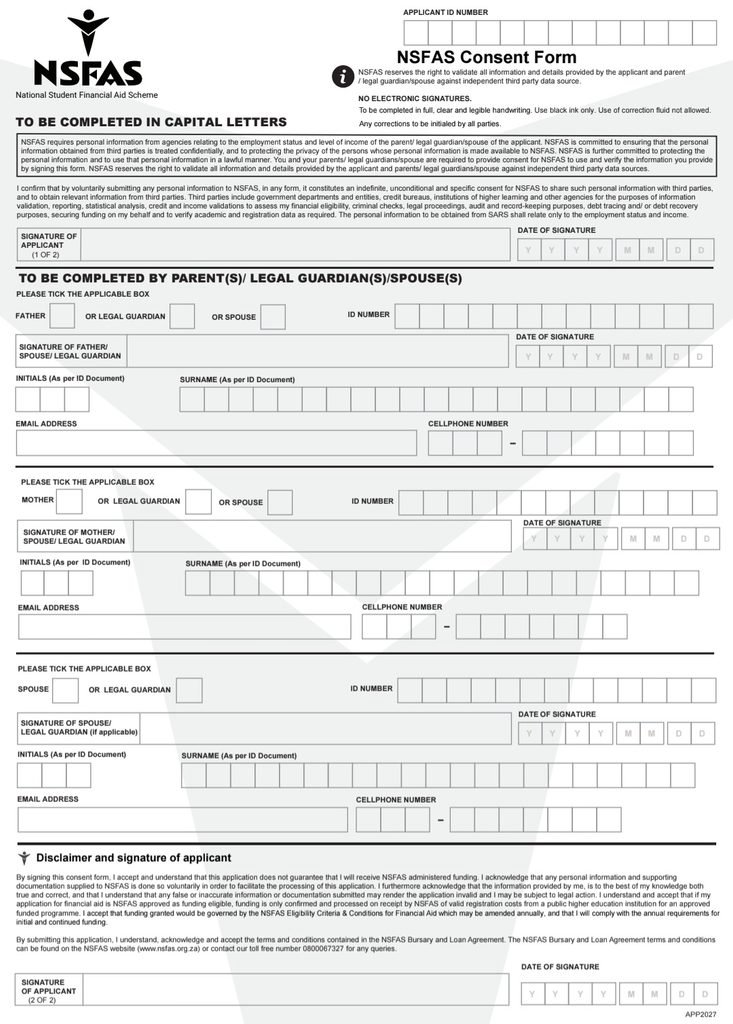
- Signed NSFAS Consent Form (Form APP2027): Mandatory for every single applicant. This form grants NSFAS permission to verify identity and household income against third-party databases, including SARS and Home Affairs.
- Identity Document: Clear copy of your South African ID or Birth Certificate (Smart ID cards must be scanned on both sides).
- Parent / Guardian Proof of Income: Payslips for the last 3 months, a UIF statement, or a sworn affidavit for informal income (where applicable).
- Death Certificates: Required if one or both parents/legal guardians are deceased.
- Divorce Decree / Settlement Agreement: Required if parents are divorced or separated and court-ordered maintenance applies.
- Proof of Legal Guardianship: Court-issued documentation if living with an appointed legal guardian.
- Disability Annexure A Form: Required for applicants living with a disability, completed and signed by a registered medical practitioner. Merge the medical report and annexure into one file before uploading.
- Vulnerable Child Declaration: Completed by a social worker for applicants under 18 who are orphans or vulnerable children.
Critical Document Rules:
- Forms must be printed and signed by hand using black ink in capital letters.
- Electronic, typed, or pasted signatures will be rejected automatically.
- Do not use correction fluid (Tipp-Ex); any corrections must be initialed by every party who signs.
- Multi-page documents must be merged into a single file before uploading.
Step-by-Step Online Application Guide
The entire application process is completed digitally through official myNSFAS portal or mobile app.
Click here to apply for NSFAS 2027
Step 1: Create or Log In to Your myNSFAS Account
Visit my.nsfas.org.za or open official NSFAS mobile app. Register using your South African ID number (which serves as your username), an active mobile number, and a valid email address. Enter the One-Time Pin (OTP) sent to your phone to activate your profile.
Step 2: Complete Personal & Household Details
Log in and accurately complete all personal details (ensure your full name and ID match Home Affairs records exactly). Provide accurate income and biographical information for all household members.
Step 3: Download & Sign Required Forms
Download the NSFAS Consent Form and any other applicable forms (e.g., Disability Annexure or Vulnerable Child Declaration). Print the forms, fill them out in capital letters using black ink, get hand signatures from all relevant parents/guardians, and scan them back into your device.
Step 4: Upload Required Supporting Documents
Check your myNSFAS portal checklist for the specific upload slots generated for your application. Upload each requested document to its correct slot, ensuring files are clear, uncropped, and readable.
Step 5: Review, Submit & Track
Review all entered details, submit your application, and save your unique reference number. Use the online Tracker in your myNSFAS account to follow your status. If notified about missing documents, you have strictly 30 working days to respond and upload the required files.
Official Contact Details & Scam Warnings
Applicants who require assistance or encounter technical difficulties can utilize official NSFAS support channels:
- Toll-Free Helpline: 0800 067 327
- Fraud Reporting Email: speakup@nsfas.org.za
- Official Portal: my.nsfas.org.za
Security Warning: Applying for NSFAS is 100% free. NSFAS will never ask for payment or request your account password or OTP. Ignore third-party agents, WhatsApp forwards, or social media accounts offering to speed up your application.
Frequently Asked Questions (FAQs)
1. Do I need to wait for my final Matric results or university acceptance before applying?
No. Learners currently completing Grade 12 in 2026 can apply immediately. You do not need to wait for your final NSC results or an official university/college acceptance letter to submit your application.
2. Do SASSA grant beneficiaries need to submit proof of household income?
No. Applicants who receive SASSA grants (such as Child Support, Foster Child, or Care Dependency grants) are automatically verified through SASSA database integration and do not need to upload proof of income.
3. What happens if I miss the 31 October 2026 closing date?
Applications strictly close on 31 October 2026 at 23:59 South African time. Late applications cannot be accepted under any circumstances, so students are strongly advised to submit early to avoid system timeouts or heavy web traffic.